
Caught in complexity: Why EU Fisheries Rules Fail in Practice
If you talk to operators, authorities, and other stakeholders in the fishing sector, you will hear the same complaints: the regulatory framework governing the Common Fisheries Policy (CFP) is too complex, too unclear, and too inconsistently applied. Until the rules are simplified and better supported through cooperation, operators will continue to experience too much administrative burden. If the rules aren’t followed, the CFP will not be enforced.
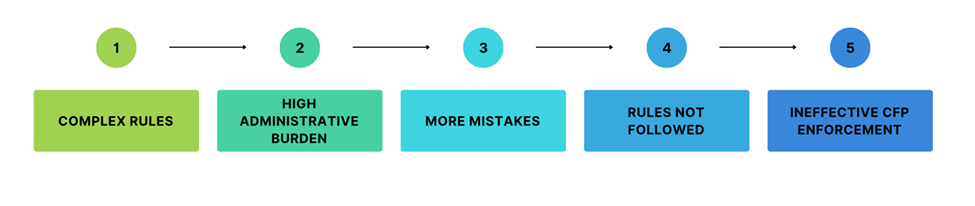
That’s where the European Fisheries Control Agency (EFCA) comes in. Since 2005, it has been responsible for coordinating inspections and supporting CFP enforcement across the EU. Operators and NGOs view EFCA’s work, particularly training, surveillance, and information sharing, as valuable. Nevertheless, there are a number of interrelated? issues that currently hold back the effective and efficient enforcement of the CFP:
- Regulatory Complexity: Operators consistently highlight the complexity of the framework itself. Attempts to simplify fisheries control, particularly through the 2009 reform, have not gone far enough. The system remains difficult to navigate, with many provisions still requiring clarification. Take the landing obligation in Article 15 of the basic CFP. It sounds straightforward, fish subject to catch limits must be retained, recorded and landed. However, the provision spans over ten paragraphs which contain various exceptions and cross references to other Union documents, such as multi-annual plans adopted by the Commission. This seemingly straightforward obligation is therefore entangled in a complex legislative network.
- Lack of Clarity: In practice, rules are often vague, open to interpretation, and applied differently across Member States. At the same time, the standards are also difficult to implement because of their rigidity. Operators have identified the following standards as particularly problematic:
- weighing practices,
- tolerances,
- transport,
- prior notification, and
- transmission deadlines
- Administrative Burdens: This vagueness and amount of obligations imposes much administrative burden on the operators, which in turn decreases compliance. While recent changes to the frameworks reduced 28% of administrative burdens to the operators, it must be noted that new obligations have also been imposed. For example, operators must now keep an electronic logbook of all fishing operations. As many vessels conduct several (and up to 20) operations a day, this requirement will increase error risk.
Ultimately, these concerns reflect one underlying issue: the rules are too complicated and insufficiently clear. This lack of understanding leads to continuous high infringement rates at around 10.5% and ineffective protection of fisheries. EFCA, being tasked with the implementation of the CFP, should take additional actions to:
- enhance cooperation,
- exchanging information, and
- clarify applicable standards
Casting a wide net: Hard or Soft Law?
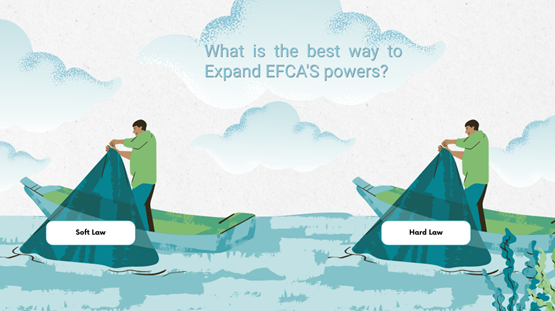
How then to ensure the right bait is employed to improve the coherence and effectiveness of EFCA’s enforcement? Two approaches may be considered, overhaul EFCA’s formal powers through hard law, and or tackle the problem within the existing legal framework through soft law solution.
Reeling in more direct enforcement powers for EFCA would require a revision to the EFCA regulation to increase their mandate and powers. Formal expansion of operational powers does not lie entirely in uncharted waters, a similar development can be observed in other EU agencies such as Frontex. Much like EFCA, Frontex started out with merely planning and coordination powers but was granted its own executive staff, resources and decision making powers following the 2015 refugee crisis. Importantly, they gained both supervisory and intervention powers giving the agency direct control over enforcement by national authorities.
Expanding powers through hard law seems attractive from an EU perspective since it can remove national disparities. This can in turn improve uniformity and compliance across Member States. However, this approach may catch EFCA swimming upstream. Revision of regulations requires political consensus, which might prove problematic when the division of powers between the EU and the Member States hangs in the balance. Additionally, the EU legislature seems to want to rely on national enforcement networks for the simple reason that powers are accompanied by resources which could put stress on the Union Budget. Of course, simplification of the CFP would also require such legislative reform which may again prove difficult in light of the attached procedures.
Alternatively, soft law instruments are not legally binding nor enforceable and are often written off as ineffective. However, the value of such instruments in the case of EFCA cannot be understated. After all, deterrence through sanctioning is not the only fish in the sea when it comes to compliance. In fact, pursuing enforcement based on positive support may better reflect the current reality regarding the CFP’s enforcement.
National authorities are struggling due to the technical nature of the enforceable norms. If the issue does not lie in opposition to the rules but rather inability to comply, direct enforcement would not incentivise national authorities to comply any more than a fish would be incentivised to bite a hook it cannot reach. Use of soft law must be navigated cautiously, overproduction of norms may cause more complexity than clarity. Nevertheless, as demonstrated below, when emphasis is put on clarification of norms to complement the CFP, EFCA may yet be able to provide operational guidance and improve accessibility through soft law instruments.
Fishing for answers: The ‘AI Act Service Desk’ and ‘Solvit’
AI Act Service Desk
One way to improve accessibility and operational guidance is to create an easy to use mechanism that increases the understanding people have of what their obligations are under the law. This can be done in a number of ways, but it is interesting to see how this issue is already tackled in other areas. For example, the AI Act is another law that is plagued by a large number of complicated rules that could negatively impact effective and consistent application. To increase effective implementation of the AI Act, mechanisms were created to provide information to those who encounter the AI Act in their work and lives. Even though the AI Act and the CFP are not completely similar, looking at how the issue is tackled in this area of EU law is a good source of inspiration.
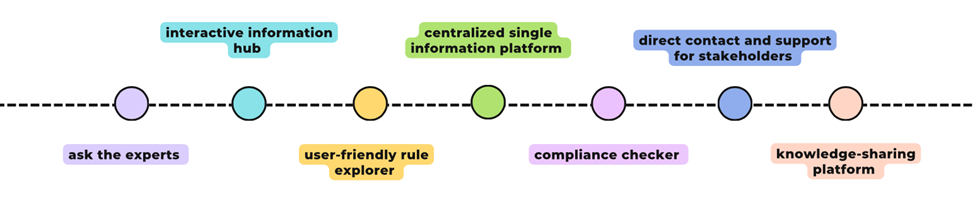
The AI Act Service Desk was designed to aid stakeholders in navigating EU law requirements on AI. This provides the stakeholders with more legal certainty as to whether they are following the laws, which would ultimately benefit the AI market in the Union. Here, individuals and organizations can ask questions about the rules to experts in the field and get further assistance on their issues. Another part of this Service Desk is the Single Information Platform, which provides online interactive tools to understand the AI Act. For example, the AI Act Explorer allows people to intuitively search for information in the Act that is most important for them, and the Compliance Checker provides a way for people to check whether their AI system is in compliance with the rules in the Act.
Additionally, the Apply AI Alliance forum was created as a space for stakeholders and the Commission to share news, opinions, knowledge and recommendations. This so-called ‘Community Exchange Platform’ is open to everyone and provides a good opportunity for those working in the sector as well as lay-persons to learn about AI and the AI Act. This platform is more focused on innovations in the field of AI rather than on the AI Act itself. However, the idea of an exchange platform where experiences can be shared between those having experience with the legislation is a useful tool to educate people.
Overall, these AI mechanisms provide examples of ways in which people can interact with the EU rules to understand how they work in an easy and user-friendly way. One potential issue with such tools, however, is how to obtain the necessary funding and resources to create and maintain them. All of the examples provided above are managed by the Commission. It remains to be seen whether EFCA can manage to recreate its own tools within their funding or whether the Commission needs to lend a helping hand in this respect. Nonetheless, the tools do provide good examples on which EFCA can build its own framework to help people navigate the vast sea of legislation that is the CFP.
Solvit
Another way through which compliance can be reached is the European Administrative Networks (EAN). One of these EANs is Solvit, an informal non-binding mechanism which handles misapplication of EU law by public authorities in cross-border movement. Solvit is a network of centres staffed by civil servants in every EU Member State, Norway, Liechtenstein, and Iceland. Its general objective is to deliver fast, effective and informal solutions to cross-border problems for citizens and businesses free of charge. This makes it an early problem-solving tool offering an alternative to Courts by bringing about changes in national administrations through exerting peer pressure to ensure compliance. At the same time, it prevents the delegation of national responsibility to supranational organisations.
Its main strength is that it is user-centric, pragmatic, and has an informal approach. Solvit has two faces: the first being a formal problem-solving network and the second being an informal network of member states engaging in discussion on the application of EU law. This shows a ‘network spirit’ where civil servants discuss matters beyond the cases and therefore become better equipped to make for an important government tool promoting compliance with the internal market. Solvit is also a strong source of information when it comes to the workings of the Single Market. This is because it also detects and monitors systemic issues in the Single Market due to these being flagged through complaints.
The power of such an EAN lies in the fact that it is a tool to close the gap between EU legislation and national implementation. By providing a middle-ground for networking interactions with a focus on joint problem solving, citizens and businesses are better equipped to use their rights and national administrations are better equipped to comply.
The enforcement of CFP could be heavily improved by this network approach. Just like a school of fishes swimming together for protection, this networking approach of best practices may fend off the non-compliant sharks in the water. This balance of having an informal network of Member States makes enforcement a less individualised matter, but benefits the whole. Not only through enforcement by itself, but through being an information system too.
In summary, a similar approach as Solvit, would allow citizens and businesses to gain more access to information and allow for increased agency in order to comply with the CFP. An EAN that translates the CFP could close the gap between the legislation and its implementation. Essentially making for smooth sailing in the often choppy waters of enforcement of the CFP and anchoring Member States to cooperative problem-solving and shared responsibility.
Reeling in the solution: Solving EFCA’s inaccessibility
The current deficiencies with EFCA’s enforcement of the CFP can be largely attributed to its inaccessibility, particularly the disconnection between the provisions and those fishermen and operators who must carry them out. This is not particularly surprising – one look at the agency’s webpage will reveal that it is almost as complex to navigate as the Regulation setting out EFCA’s tasks and competences. The online page contains little information on the agency beyond its general mission and current activities, causing those working in the field who seek clarity on the implementation of certain provisions to feel like fish out of the water.
With this in mind, the following soft-law solution can be brought forward to remedy the agency’s inaccessibility. In light of the widely successful EU initiatives of ‘Solvit’ and the ‘AI Service Desk’, the EFCA could adopt some of these ideas and introduce a direct line of contact with legal experts through its webpage. Much like ‘Solvit’, the EFCA website should include an ‘Ask the Experts’ tab where those knowledgeable on how the implementation of the CFP works in practice can answer those who are less experienced in real time.
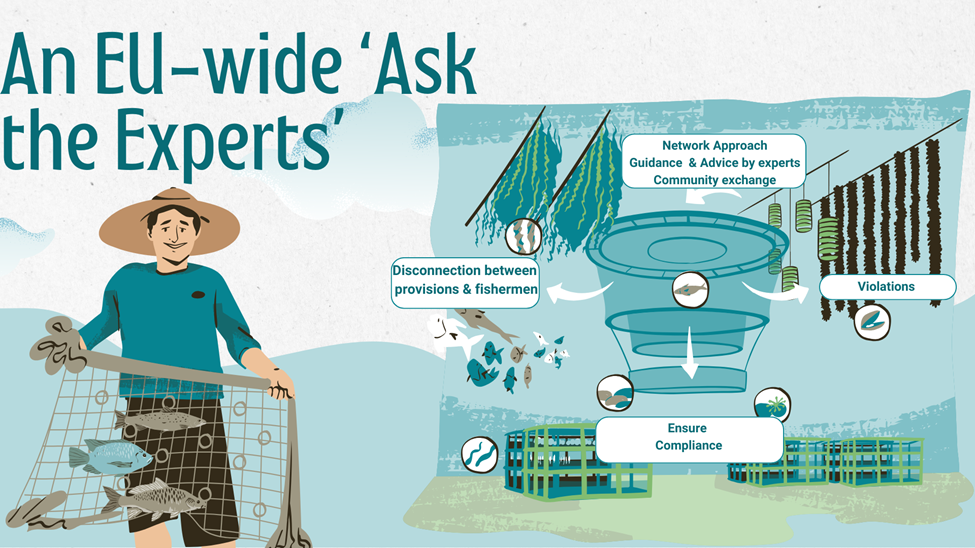
One might reasonably wonder why this should be an EU matter. At first glance, it might seem that the EU has bigger fish to fry. Why should the EU offer a solution to what seems like a national implementation problem? The answer is simple – EFCA comprises almost 2000 Union inspectors and 3000 trained officials coming from all 27 Member States. As such, it contains a wider circle of experts than any national fisheries agency. An EU-wide ‘Ask the Experts’ line would therefore create a wide and diverse network of specialists in the field who can provide up-to-date information to any fisheries professional within the Union.
The bottom line is that, as proven by past EU-driven initiatives, the best way to ensure compliance with the agency’s complex rules is to bring these laws closer to the very people who are expected to implement them. By bringing industrial operators and fishermen into direct contact with legal experts who can easily answer their questions, EFCA will streamline the current national and individual compliance of the CFP. In doing so, the agency will strengthen the professional development of these individuals, ensuring the long-term sustainability of our waters and echoing the familiar proverb that “if you give a man a fish, you feed him for a day; if you teach him how to fish, you feed him (and our fisheries) for a lifetime.”
- Blog post by Mary, Marjorie, Justin, Samuel and Naima - April 8, 2026
- Accountability in EU pharmaceutical enforcement: the problem of many hands - April 8, 2026
- The European Defence Agency: All Vision, No Bite? - April 8, 2026
