
The forthcoming publication by IVAP of the book From Europe to Basque Municipalities: Multilevel Governance and Citizen Participation in the Resettlement of Refugees, following its receipt of the runner-up award in the 2025 Leizaola Prize, provides an opportunity to reflect on an issue of growing legal and political importance: how to design effective, coordinated and legitimate responses to the resettlement of refugees.
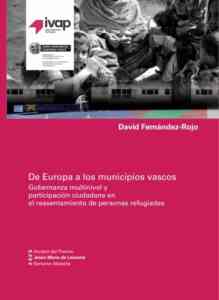
The forthcoming publication by IVAP of the book From Europe to Basque Municipalities: Multilevel Governance and Citizen Participation in the Resettlement of Refugees, following its receipt of the runner-up award in the 2025 Leizaola Prize, provides an opportunity to reflect on an issue of growing legal and political importance: how to design effective, coordinated and legitimate responses to the resettlement of refugees.
In light of the unprecedented levels of forced displacement and the escalating global conflicts, resettlement has emerged as a pivotal element of international protection policy. However, its development remains limited and uneven. This monograph starts from that premise and approaches resettlement not only as a legal or humanitarian instrument, but also as a matter of public governance. The central question is straightforward: how can the European Union, the State, the autonomous communities, municipalities and civil society work together to provide a more robust response to this challenge?
From this standpoint, the study places multilevel governance at the core of its analysis. The central argument is that a combination of self-government, administrative decentralisation and citizen participation can strengthen institutional reception capacity, facilitate the early integration of resettled persons and reinforce the social legitimacy of refugee policy. Resettlement is therefore presented not as an issue belonging exclusively to the State or to supranational institutions, but as a process involving multiple levels of decision-making and responsibility.
The monograph commences by examining the evolution of the European framework. The adoption of Regulation (EU) 2024/1350 was a significant milestone, as it established a permanent framework for resettlement and humanitarian admission in the European Union for the first time. At the same time, the analysis highlights the limitations of this development. Participation by Member States remains voluntary, with no binding quotas having been introduced, and significant room for national discretion persists. Consequently, the European system persists in functioning within the tension between the necessity for a unified response and the reluctance of member states to accept binding commitments in a particularly sensitive field.
The book also examines the Spanish case, where resettlement is legally sound but implementation remains challenging. Alongside an analysis of the legal framework governing resettlement in Spain, the monograph underlines issues such as inter-administrative coordination, the effective implementation of national programmes, and persistent shortcomings in transparency and accountability. In this respect, it demonstrates that the existence of legal rules is not in itself sufficient: the real scope of any public policy also depends on its implementation and on the quality of the reception it ultimately provides.
A key finding of the research is the comparative study of three community sponsorship pilot programmes: Auzolana II is located in the Basque Country, SOMOS is based in Navarre, and Agermanament Comunitari Valencià is situated in the Valencian Community. These cases demonstrate the potential for citizen participation, in collaboration with public authorities and social organisations, to create new pathways for the reception and integration of refugees. Community sponsorship is therefore a form of shared governance that brings proximity, co-responsibility and territorial rootedness to policies that have traditionally been designed through more centralised frameworks.
In this comparative approach, the Basque case is of particular significance due to the development of Auzolana II as a pioneering community sponsorship initiative promoted at regional level. The programme provides a valuable case study for examining the interaction between the central government, the Basque Government, municipalities and social organisations, as well as the role citizens can play in reception processes. Beyond its practical dimension, Auzolana II also invites reflection on self-government not merely as a matter of competences, but as a means of institutional innovation.
The comparison with Navarre and the Valencian Community broadens the analysis and helps identify both opportunities and limits. The programmes have the capacity to personalise reception, mobilise community networks and strengthen public support for resettlement policy. The main challenges are as follows: the absence of a stable legal framework, the need to guarantee long-term funding, coordination with the national reception system, and compliance with the principle of additionality. Finally, it is vital to emphasise that places established through community sponsorship should complement, rather than supersede, existing public resettlement commitments.
The monograph’s central argument is that the resettlement of refugees necessitates a shift in perspective, moving beyond a solely vertical interpretation of public action. It is clear that no single administration can respond on its own to a challenge of this scale and complexity. It is therefore essential to establish cooperative arrangements across levels of government and to integrate civil society into the institutional response in a structured way. Citizen participation is not regarded as a supplementary element, but rather as a factor that can enhance the effectiveness, sustainability and democratic legitimacy of reception policies.
In this context, the monograph proposes an understanding of resettlement as a field in which law, public policy and social participation intersect. Its trajectory, from the European level to Basque municipalities, demonstrates that international protection is contingent not only on major normative decisions, but also on the capacity to translate these into concrete practices of reception. In the current climate of political and social tensions surrounding migration, this reflection invites a re-evaluation of resettlement through the lenses of shared responsibility, institutional cooperation and civic commitment.
This blog post is part of the TECHMIGOV Project PID2024-155479NA-I00, funded by MICIU/AEI/10.13039/501100011033 and by FEDER, EU, PI D. Fernández-Rojo.
The blog post on eulawenforcement.com is a re-post from the ‘Caught you Red-handed’ blog platform.

- [REPOST] From Europe to Basque Municipalities: Multilevel Governance and Citizen Participation in the Resettlement of Refugees - May 31, 2026
- An Enforcement Role for EUROPOL in the Aftermath of the “Refugee Crisis”? - May 31, 2018
- It’s a new agency. It’s a federal agency. It’s the European Border Coast Guard!No wait… it’s Frontex - February 28, 2017
