
Frontex Could Play a Key Role in Preventing Member States from Keeping in Place Unjustified Internal Border Controls
By Noëlle, Isabel, Henrike, Hannah
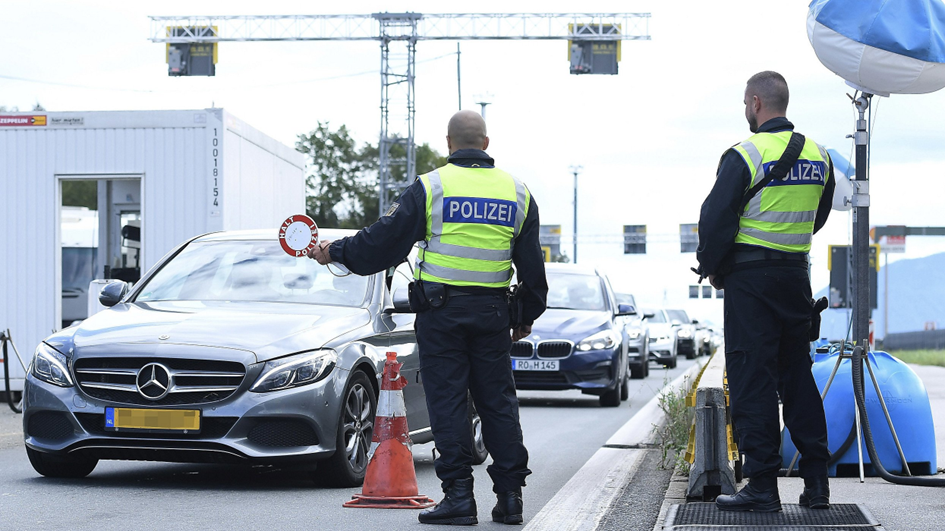
This year, during March and April, the periodic Schengen evaluation programme targets Germany to assess the alignment of its policies with the Schengen acquis. Its record regarding the “absence of internal borders” (Article 1(3) Council Regulation (EU) 2022/922) will look very grim. The objective of establishing an area without internal frontiers (Article 3 TEU) has always been accompanied by commitments to effective migration management at external borders. Within the current political dynamic this interdependency materialises as “quasi-permanent” internal border controls. This seriously undermines the promise of Schengen as a borderless area. The paralysis to address these ongoing breaches of EU law and values calls for alternative, innovative approaches to “save Schengen”.
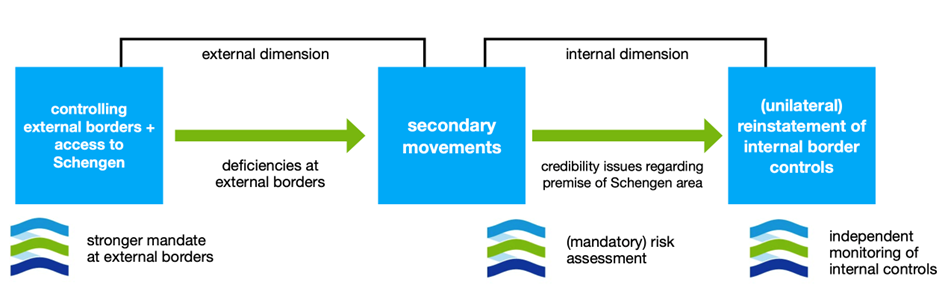
Notwithstanding the limitation of its mandate to external borders, it seems worth exploring what (indirect) impact the EU’s border and coast guard agency, Frontex, has on the internal dimension. This allows to identify three main stages in which Frontex’s stronger involvement could mitigate uncoordinated national measures: enhanced operational support at external borders, making its risk assessment a mandatory criterion for reinstating unilateral internal border controls, and independent monitoring of such controls by Frontex. Of course, concerns about Frontex’s fundamental rights and accountability obligations must be taken very seriously. However, strengthening such a supranational actor could resolve credibility issues and help re-establish a rule-based management of an area without internal frontiers.
Putting Schengen at risk
The Schengen Borders Code (SBC) balances rules for managing external borders against the default mode of an area without internal border controls. Only as an exception and under strict conditions does Article 25 SBC allow Member States to reinstate internal border controls: they must be temporary, a means of last resort, and address a serious threat to public policy and national security. Depending on the reasons, Member States can prolong internal border controls beyond the initial period of six months. Their overall duration must not exceed two years and under all circumstances be proportionate (note that before the adoption of the SBC’s reform, these time limits were even stricter).
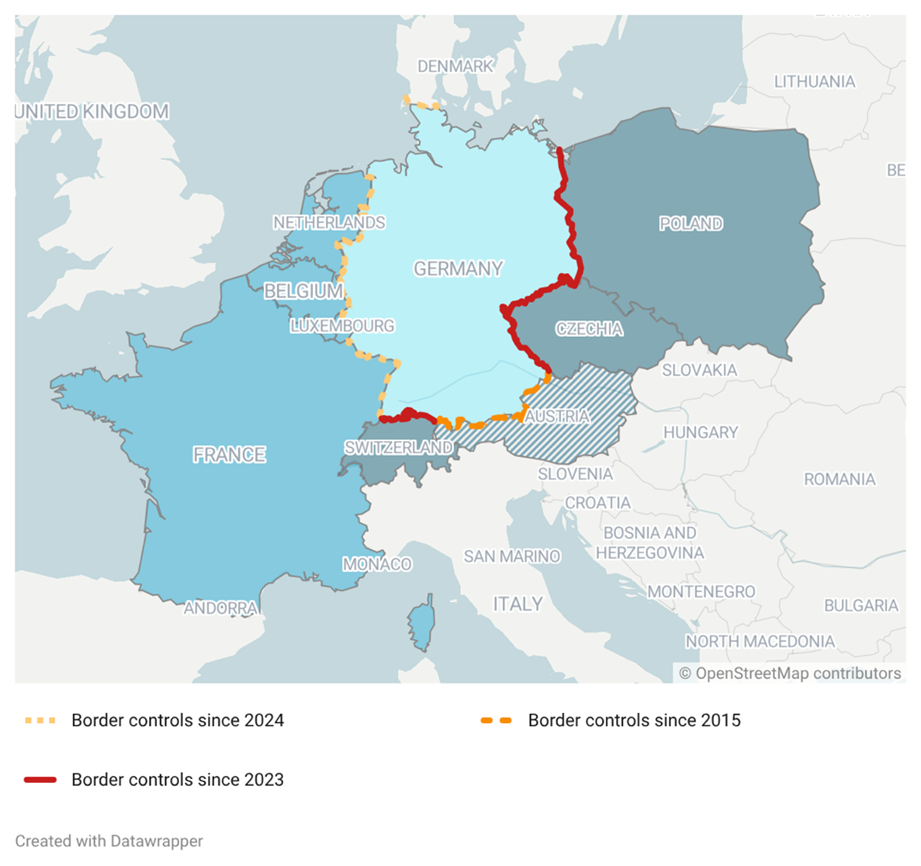
However, the current reality looks quite different. As of May 2025, a total of eleven Schengen states had put in place internal border controls for concerns about irregular migration and security. Germany has continuously expanded the scope of its internal border controls. Since September 2024, controls take place at all land borders, with the latest renewal on 15 March 2026. Given that since 2015, France, Denmark, Norway, Sweden and Germany have continuously prolonged internal border controls for migration-related security concerns, it is fair to speak of de facto permanent internal border controls which are in effect burying Schengen.
There is wide-spread scholarly critique on the weak justification for internal border checks and their continuing renewal. Also, national courts are positioning themselves to bring Schengen back to life. The Bavarian administrative court declared Germany’s current border controls to be in violation of the time limits laid down in Article 25 SBC. In its ruling, the court relies on a previous ruling by the European Court of Justice (CJEU), which came to similar conclusions in the case of Austrian border controls. The CJEU emphasized that the free movement of persons is a fundamental achievement of EU integration. Thus, exceptions are to be interpreted strictly (para. 65 and 74). It also confirmed that Article 25 is sufficiently clear in striking a balance between the competing objectives of protecting national security and maintaining an area without internal borders (para. 89).
Rethinking Schengen
Yet, it seems like the legislature felt urged to correct the CJEU’s conclusion in its reform of the Schengen Borders Code in 2024. It inserted the “sudden large-scale unauthorised movements of third-country nationals between the Member States” as an explicit justification ground (Article 25(1)(c) SBC) for reinstating temporary border controls. Already the previous episodes of internal border controls could be considered a “valve that signals a malfunction of the Schengen Area.” The amendment reflects the underlying political dynamic in which northern Member States aim to prevent high inflows of secondary movement. This refers to migrants’ irregular onward journey whereas under existing EU rules other Member States should take responsibility for their asylum and return procedures. In the view of countries like Germany, secondary movements are a sign of the dysfunctional management of external borders. For the German government, strengthening external borders is a prerequisite for reopening the Schengen area. This interdependency fuels distrust between Northern Member States and Member States at the external borders. Moreover, it risks recourse to uncoordinated unilateralism, further putting the premises of the Schengen Area under pressure.
What remains is the search for solutions that again succeed in reconciling these interdependencies. In that regard, it is important to recall the supranational procedure in Article 29 SBC. It is specifically designed for situations “where exceptional circumstances put the overall functioning of the area without internal border control at risk”. Such cases require the Council to adopt a common recommendation on reinstating internal border controls. Frontex is plays a role in this supranational procedure as well as for Member States’ individual decisions under Article 25 SBC.
Frontex’s involvement in border control
The EU is increasingly creating agencies to delegate certain responsibilities, especially for implementing policies more effectively and depoliticising technical tasks. Frontex is the answer to this agencification in the area of border management. It is a EU body created to offer support in all aspects of border management within a system without internal border checks. The EU’s competence for this area is enshrined in Article 67(2) TFEU for common external border control and Article 77 TFEU, which provides the legal basis for border management policy. Frontex’s mandate and competences are set out in the Regulation on the European Border and Coast Guard, focusing on support for the Member States at external borders through coordination, operational assistance, and risk analysis. The primary responsibility for border control remains with the Member States, which exercise their sovereign powers. Frontex acts through joint operations that always involve the host state’s consent and cooperation. The staff usually acts under the command of national authorities and under national law, within the EU framework. The Member States’ cooperation with the agency includes sending national personnel and technology. Germany, for example, currently supplies Frontex with 160 federal and state police officers. Frontex’s role is deliberately focused on external borders, as mentioned in recitals 1 and 34 of the Regulation’s preamble, having practically no mandate at internal borders.
Frontex’s internal reach?
Nevertheless, Frontex has indirect influence on internal border controls through different interacting mechanisms. The basis for this is the risk assessment laid down in Article 29 Regulation 2019/1896 (Frontex Regulation). This assessment should give an evidence-based view of the pressures and threats at the EU’s external frontiers and should provide Member States with the data intelligence, and strategic insights required to prepare effectively. Frontex receives information for the assessment to a large extent from national border agencies, making it highly depended on the Member States. However, this makes Frontex’s reports more comprehensive than reports of other organisations and creates motivation for policy makers to use them.
In recent years, also surveillance, which had previously been limited to external borders, has been expanded to include collecting data on the movement of persons inside the EU. Although Frontex’s focus is on external borders, the risk assessment always includes information on secondary movement. This is especially interesting for Member States like Germany, which have no external borders but can take Frontex’s risk analysis as a reference point. An incentive to do so constitutes the Schengen evaluation and monitoring mechanism. Using this mechanism, the Commission assesses Member States’ compliance with the Schengen acquis. Based on Frontex’s risk assessment, it will be evaluated what Member States can do in regard to internal border controls. Here, Member States’ willingness to integrate Frontex’s risk assessment as a systemic part of their national border control strategies counts as a proxy for compliance. In the beginning of this evaluation mechanism, the evaluation and monitoring were conducted by the Schengen Evaluation Working Party of the Council, which was composed of Member States’ representatives. Later it was shifted to Frontex, based on typical arguments in favour of agencification. The Commission criticised the process as an insufficiently strict and transparent peer-review. The Council, on the other hand, wanted to limit the Commission’s power in this procedure.
Can Frontex save Schengen?
Based on these existing competences in risk assessment and Schengen evaluation, Frontex could play a key role in breaking the vicious cycle created by the interdependency between controlling external borders and abolishing internal borders.
Ideally, Frontex becomes more strongly involved in supporting Member States at external borders. This is essential to safeguard the foundational premise for a functioning Schengen Area: effective control of access to the territory in the first place.
In the meantime, Frontex’s mandate should contribute to restoring credibility of commitment to EU law on border management. Member States shall be obliged to justify their internal border controls solely on Frontex’s risk assessment in relation to the ground of unauthorised movement in Article 25(1)(c) SBC. This can be part of a broader framework of benchmarks for the incremental abolishment of internal controls.
In the alternative, and as the weakest form of involvement, Frontex should obtain a leading role in monitoring and evaluating the compatibility of unilaterally reinstated border controls. This means that Frontex should assess their effectiveness considering the national security objectives that Member States have presented as well as the negative effects of such reinstated border controls. Both approaches mitigate the competing objectives between national control over territorial access, and the long-standing come back of an area without internal frontiers.
This blogpost can just be a first glimpse in this direction, and it invites for innovative thinking on institutional solutions for breaking the current deadlock in Schengen governance. Also, every expansion of Frontex’s mandate must clearly go hand in hand with more robust fundamental rights protection and accountability mechanisms. That being stated clearly, strengthening the involvement of a supranational agency like Frontex could contribute to recovering common, rule-based management of the Schengen area. Eventually, such an approach must not lose sight of the Member States’ and the Commission’s responsibility for ensuring respect for the law. Frontex’s role in internal border management may provide a promising starting point.