
Europe is spending more on defence than ever, but rising budgets have not been matched by greater coordination. This blog post explores the economic rationale behind the EDA, its historical development, and how its role may need to evolve in today’s shifting geopolitical landscape.
By Martin, Alexandra, Gillis and Julia
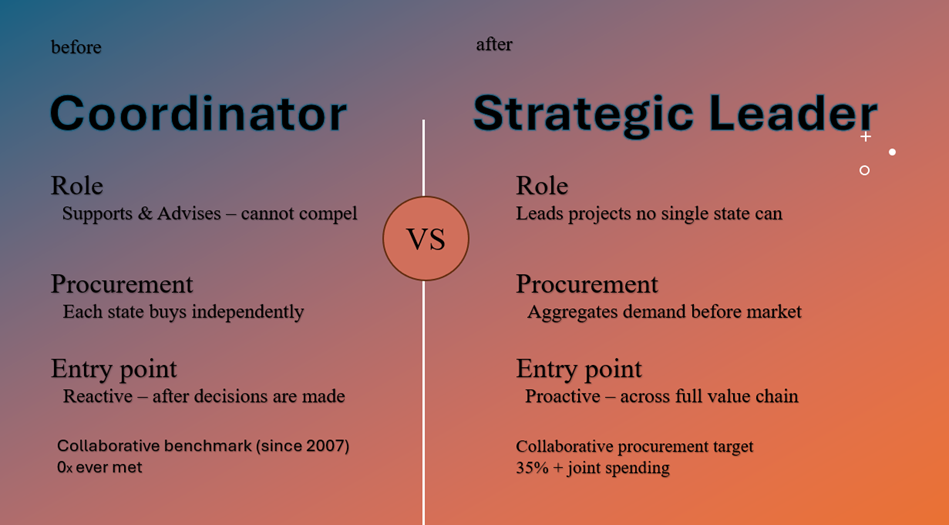
While defence is and has always been a national responsibility of each European Union (EU) Member State, defence coordination and efficiency is now more important than ever. The European Defence Agency (EDA) was founded in 2004 to promote defence collaboration in the EU and to support integration within the EU’s Common Security and Defence Policy (CSDP) between Member States. Although defence spending has gone up in Member States, the collaborative procurement benchmark has consistently gone unmet, not because the EDA has failed as such, but because Member States have not made sufficient use of it for their joint procurement. The Agency can facilitate cooperation; it cannot compel it. This is why it has often been criticised for lacking teeth.
This blog post will therefore explore the economic reasoning of collaborative procurement behind the EDA and its historical development, after which the current geopolitical context will be analysed and how the EDA could and should react to this. This blog post argues that the EDA could be redesigned, by implementing several reforms and aligning its tasks with the current geopolitical context.
Spending More, Wasting Less
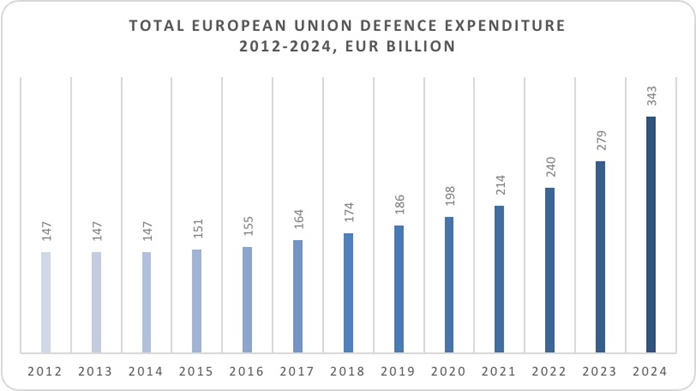
Europe is arming up. The EU’s 27 Member States spent €343 billion on defence in 2024 alone. But more money does not automatically buy more security. Part of the challenge is efficiency: turning each euro into more real military capability. Yet efficiency is only one side of the picture. European security depends at least as much on whether Member States are politically willing to use the capabilities they hold, as the response to Russia’s war in Ukraine has made clear. Even the best-equipped forces add little to collective security without the shared political will to deploy them. The EDA can help make spending more efficient, but it cannot manufacture that political will, which remains firmly with the Member States.
Efficiency can be achieved through quicker procurement, fewer duplicated national projects, and forces that can work together when it matters. That is the core economic argument for European defence cooperation. If Member States keep spending, buying, and developing in parallel, a great deal of that money risks being lost to fragmentation and inefficiency instead of being turned into usable collective strength.
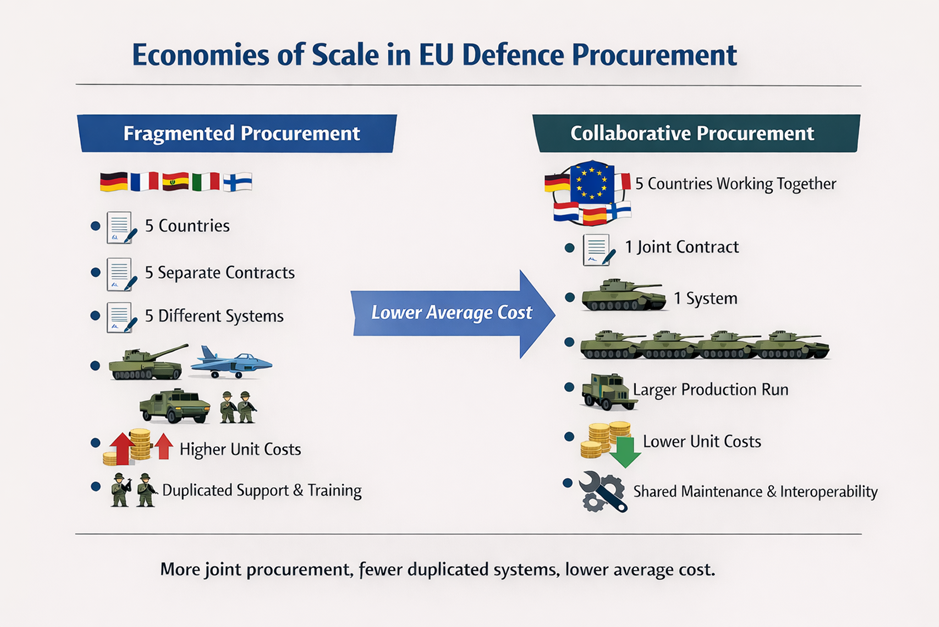
At its core, the idea is straightforward, cooperation can help Member States to get more value from every Euro they spend. Defence equipment is extremely costly to research, produce, maintain, and upgrade. When each State follows its own path, defence orders stay small, due to limited national demand and technical standards that differ. Furthermore, national forces may end up utilizing systems that do not work well together within cross-border integrated forces. Economists describe this as a problem of fragmentation and the loss of economies of scale. In simple terms, the Member States individually, without coordinating their efforts, can end up paying more for less.
Defence can also be described as a special market. Governments do not buy ammunition, tanks or missile systems the way consumers buy groceries, phones or cars. National security concerns, political sensitivities, and domestic industrial interests often keep procurement focused and protected within national borders. This makes coordination harder, but also more necessary. The more procurement remains nationally fragmented, the greater the risk of duplication, incompatibility, and inefficient spending. The European Commission has repeatedly argued that a more integrated European defence market would support larger-scale production, stronger innovation, and more efficient procurement outcomes across borders.
Seen from this perspective, the economic rationale behind the EDA is not simply about “more Europe”. It is about reducing costs, overcoming coordination problems, and helping Member States turn rising defence budgets into stronger, more compatible, and more efficient capabilities.
The European Defence Agency
The EDA was established in 2004, at a time when European governments were becoming increasingly aware of a growing contradiction in their defence policies. On the one hand, security challenges were becoming more complex and often required collective responses. On the other hand, defence remained highly fragmented, with each Member State planning, spending, and procuring largely on its own.
This fragmentation was not a new problem, but it became more visible in the early 2000s. The EU’s experience in the Balkans during the 1990s exposed limitations in Europe’s ability to act cohesively in crisis situations. At the same time, global developments such as the September 11 attacks reinforced the need for more coordinated approaches to security and defence. European countries were also facing increasing pressure to do more with limited resources, while still maintaining a wide range of national military capabilities.
In light of these developments, the EDA was established to help address a key question: how can European countries cooperate more effectively in defence without giving up control over their own armed forces?
The Agency’s original legal basis was set out in a 2004 Joint Action under the EU’s Common Foreign and Security Policy. Its role was later formalised in the Treaty of Lisbon, where Article 45 of the Treaty on European Union defines its main tasks. These include identifying capability gaps, encouraging cooperation between Member States, supporting defence research and industry, and evaluating whether agreed commitments are being followed. Its current structure and functioning are further detailed in Council Decision (CFSP) 2015/1835.
Notably, the EDA was not designed as a powerful central authority. Instead, it was conceived as a facilitator, an institution that could bring Member States together, provide expertise, and promote cooperation, without overriding national sovereignty. In other words, it reflects a broader EU approach to defence: improving coordination rather than centralising control.
Academic observations highlight this balancing act. Some scholars argue that the EDA represents a pragmatic solution, allowing states to work more closely together while keeping ultimate authority at the national level. Others point out that this same design also limits its impact, as cooperation ultimately depends on whether Member States choose to follow through on shared priorities.
In this context, the creation of the EDA was less about transforming European defence overnight, and more about managing an existing tension: the need for collective action in a policy area that remains deeply tied to national sovereignty. This tension continues to shape both the Agency’s role and its limitations today.
A New Geopolitical Era
After Russia’s invasion of Ukraine, which led to ammunition shortages in the Ukraine and the EU, supply-chain pressure and wider uncertainty about European security, Member States have faced pressure to procure their military goods as quickly and efficiently as possible. The last years have however shown that this increase in urgency has not led to increased cooperation and that Member States still often value their sovereignty more than collectively procuring military goods. This may lead to duplication and over-reliance on non-EU suppliers.
This is also shown by the EDA’s collaborative procurement benchmark, set since 2007. As mentioned previously in this blog post, this benchmark has never been met. While the EU has estimated that the total EU defence expenditure has reached €381 billion in 2025, this increased spending has not been accompanied by a proportional increase in joint procurement among Member States.
An example of this is the French and German Future Combat Air System (FCAS), EU’s next generation fighter jet program, which aimed to improve the EU’s strategic autonomy and increase cooperation. While this could have been a great way to enlarge collaborative procurement among Member States, the FCAS has been described as potentially collapsed after Germany chose to purchase United States’ F-35 combat aircrafts instead of developing and procuring these via the FCAS-program.
The European Defence Agency 2.0
As described above, the geopolitical context in which the EDA operates has changed significantly since its establishment in 2004. Defence procurement has grown and become more urgent, but not necessarily more coordinated. While the industry grows, the economic inefficiencies, as described in section I, remain. This is where the redesigned role of the EDA comes in. By increasing coordination along the procurement chain, the EDA can address inefficiencies. Putting this into practice, requires structural rethinking the role of the EDA.
Any case for a stronger EDA has to be made against the institutional reality that the most supranational role in European defence is currently played not by the EDA but by the Commission. It is a question this section returns to below.
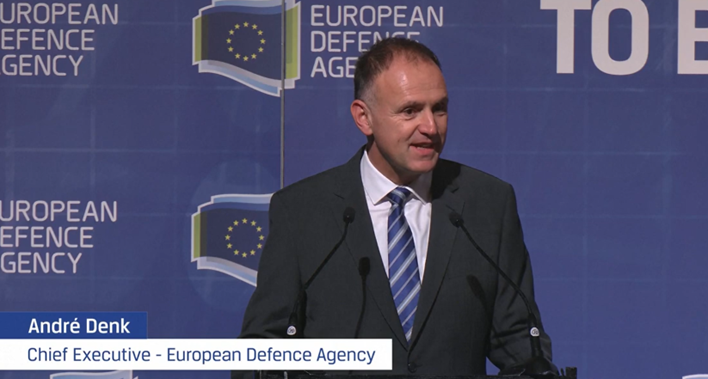
According to André Denk, EDA’s chief executive, the desire from Member States to do more on defence at EU level in line with the EU’s Defence Readiness 2030 programme, has increased. Denk introduced the redesigned role of the EDA in response to this call from Member States and the current turbulent geopolitical times. While the EDA’s traditional role remains, in essence, to coordinate rather than to centralise control, the amount of Member States in favour of expansion of the EDA’s mandate is rising. Denk called on Member States to: “use us to take forward the projects that one member state cannot.”
This call for a redesign of the EDA was also supported by former Estonian Prime Minister and current High Representative of the Union for Foreign Affairs and Security Policy, Kaja Kallas. Kallas made a statement on the inefficiencies in EU defence procurement. She spoke about the lack of complementary procurement, the focus on national interest, and persisting fragmentation. Kallas concluded that the EDA needs to lead, not just facilitate, thereby expressing her vision for a stronger EDA.
Coming back to the EDA’s core tasks, these were designed as open norms. The redesign therefore does not change the Agency’s architecture so much as the use Member States are prepared to make of it. As defence ministers increasingly speak with a sense of urgency, the space for the EDA to coordinate widens accordingly. In other words, a revised role for the EDA does not require a new agency; it requires Member States to make fuller use of the one they already have.
Two caveats follow from this. First, this is a willingness to procure together, which is not the same as a willingness to act together: even a Europe that buys efficiently and fields interoperable forces contributes little to its own security if Member States are unwilling to deploy what they own, as the halting response to Russia’s war in Ukraine has shown. A stronger EDA can close a capability gap; it cannot close a resolve gap. Second, the EDA is not the only candidate for that coordinating role.
The EDA proposed five revised lines of action:
- Scaling up research;
- Consolidating EDA’s central capability role;
- Support joint procurement;
- Secure resources;
- Leveraging existing partnerships.
Apart from increasing budgets for already existing competences, the EDA’s goal is to take a more prominent role in the supply chain. In practice, this results in the EDA to target shared requirements for joint acquisition before contracts are put to market. This strategy can improve efficiency in concrete ways. When demand is aggregated earlier and common requirements are established at the EU level, Member States can benefit from larger production runs, reduced unit costs, and greater leverage with suppliers. Furthermore, existing partnerships with, for example, Ukraine, Turkey and Canada are to be strengthened under the EDA procurement framework. This redesigned EDA is stepping beyond pure facilitation and increasingly towards centralisation, answering the Member States’ calls.
Important to note is that the EDA operates within fixed structural limits. It does not control national defence budgets, cannot compel Member States to procure jointly, and works alongside existing frameworks such as NATO. Any case for a stronger EDA must also be placed in its wider institutional setting. In recent years, the most visibly supranational role in European defence has been played not by the EDA but by the European Commission. The Commission has increasingly shaped defence policy through funding and joint procurement instruments, from the European Defence Fund to more recent readiness and common procurement initiatives, despite the Treaties providing no defence specific legal basis for the Commission to do so. As Meershoek has shown, this expansion has been built largely on internal market and industrial policy competences rather than on any defence mandate proper, which makes the Commission’s authority in this field real but legally awkward. A more powerful EDA would therefore not be filling an empty space; it would have to be positioned alongside the Commission, raising a genuine question of institutional balance. Either way, the shift towards a modern, strategic EDA 2.0 depends not on institutional reform alone but on genuine political willingness among Member States to use the EDA for the projects that no single country can advance on its own and on clarifying how its mandate fits with the role the Commission has already assumed.
Coordination Is No Longer Enough
The EDA exists to help EU Member States coordinate and work together more effectively in defence: the idea is simply that cooperation can help countries avoid duplication and waste, save money, and build capabilities that work better together. But the EDA was never given strong powers of its own: it was designed to support and coordinate, not to force Member States to act. As this blog post has argued, the collaborative procurement benchmark has gone unmet not because the Agency has failed, but because Member States have not chosen to use it, and that has become harder to defend as spending rises fast while joint procurement remains limited. A stronger, more strategic EDA could help close this gap. Efficiency is not the same as security: even a well-funded, well-coordinated Europe adds little to its own defence if Member States lack the political will to use their capabilities when it counts. The EDA is not the only supranational actor in this space, the European Commission has increasingly driven European defence policy, so the real question is one of institutional balance rather than a simple case for a bigger EDA. A stronger EDA is therefore worth pursuing, but only if it is matched by genuine political will among Member States and by clarity about how its role fits alongside the Commission’s.

- Blog post by Mary, Marjorie, Justin, Samuel and Naima - April 8, 2026
- Accountability in EU pharmaceutical enforcement: the problem of many hands - April 8, 2026
- The European Defence Agency: All Vision, No Bite? - April 8, 2026
